
Can Sitting on the Toilet Too Long Cause Piles?
What research says about long toilet sittings, phone use and piles, how long is too long, and simple habits that help, explained by the piles specialists at Good Morning Hospital, Thergaon.
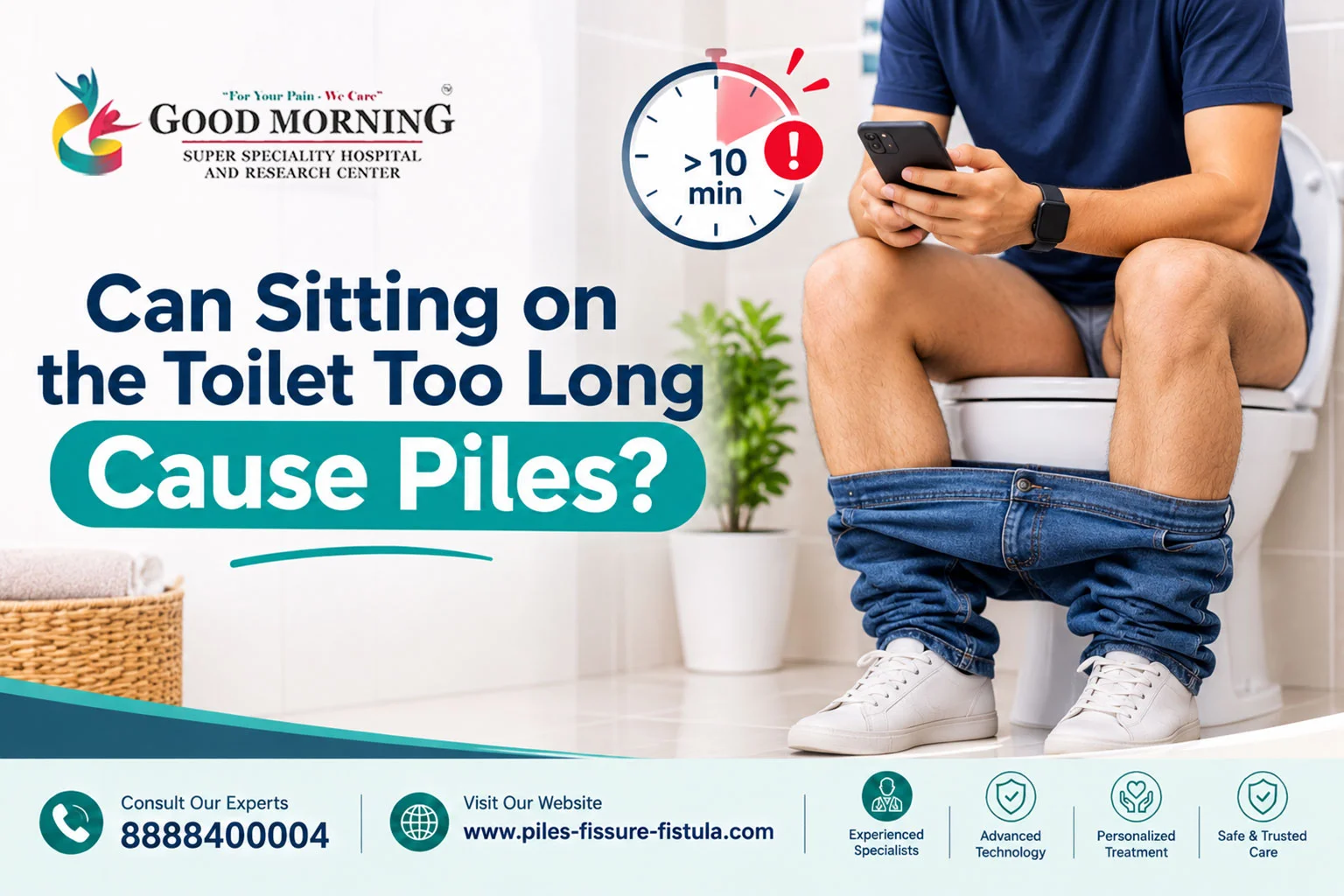
Yes, it can. Sitting on the toilet for too long is linked to a higher chance of piles, especially when the extra minutes go on scrolling a phone rather than passing stool. It is rarely the only cause, but it adds steady pressure to a part of the body that is already delicate. The good news is that this is one of the easiest habits to change.
Piles (haemorrhoids) form when the vein cushions inside and around the anal canal become swollen and inflamed. Common signs are bleeding, itching, swelling and soreness. In this guide, our team at Good Morning Superspeciality Hospital and Research Center in Thergaon, Pune explains what research says about toilet time and piles, how long is too long, and what you can do about it.
Quick answer: Long toilet sittings can contribute to piles. A 2025 study linked phone use on the toilet to a higher chance of haemorrhoids, mainly because people sit longer than they realise. Aim to finish in about five minutes, leave the phone outside, and see a doctor if bleeding, pain or a lump does not settle.
In this guide
Can Sitting on the Toilet Too Long Cause Piles?
Long toilet time can contribute to piles, but the research shows an association, not proof of cause. The strongest recent evidence is a 2025 study published in PLOS ONE by researchers at Beth Israel Deaconess Medical Center in Boston.
The study at a glance
- 125 adults having a screening colonoscopy answered questions about their toilet habits, and haemorrhoids were checked during the procedure.
- About 43% had haemorrhoids, and 66% said they used a smartphone on the toilet.
- 37.3% of phone users sat for more than five minutes per visit, compared with 7.1% of non-users.
- After adjusting for age, sex, BMI, exercise, straining and fibre intake, phone use was linked to a 46% higher risk of haemorrhoids.
Interestingly, straining was not independently linked to haemorrhoids in this study, and the authors suggested that prolonged sitting may matter more. That does not mean straining is harmless. Doctors still treat constipation, straining and low fibre intake as common risk factors.
The study was small, relied on self-reported habits and looked at one point in time, so it cannot prove that long toilet time directly causes piles. It does support a simple, safe habit: keep toilet visits short.
Why Long Toilet Sittings Put Pressure on Piles
Everyone has soft cushions of blood vessels in the anal canal that help control stool. When you sit on a toilet seat, your pelvic floor hangs over the open bowl without support, so more pressure falls on the veins in this area. Researchers suggest that long sittings without support may increase pressure on these cushions.
Over time, repeated pressure can lead to:
- Swelling of the blood vessel cushions
- Weakening of the tissue that holds the cushions in place
- Bleeding, itching, or a lump that comes down during stool
A few extra minutes every day, repeated for months and years, can add up more than most people expect.
How Long Is Too Long on the Toilet?
There is no strict rule, but researchers suggest keeping toilet time under about five minutes. Use this as a general guide:
| Time per visit | What it usually means | What to do |
|---|---|---|
| Under 5 minutes | Normal for most people | Keep it up |
| 5 to 10 minutes | You may be waiting, scrolling or pushing | Cut the extra time and leave the phone outside |
| Over 10 minutes, most days | Too long. May point to constipation or a habit problem | Change the habit, and see a doctor if you still struggle to pass stool |
You may be sitting too long if:
- You need to push hard to pass stool
- You stay seated hoping the urge will return
- You feel pressure or heaviness around the anus when you stand up
- Phone, news or social media has become part of your toilet routine
Does Using a Phone on the Toilet Make It Worse?
The phone itself does not cause piles. The problem is time. When you are absorbed in a screen, minutes disappear. In the study above, reading news and using social media were the most common phone activities, and users often did not realise how long they were sitting.
If you find it hard to leave the phone outside, start by setting a five-minute limit. Most people notice that their bowel movement does not need the extra time.
8 Toilet Habits That Help Protect You from Piles
Keep it short
Aim to finish in about five minutes. If nothing happens, get up and try again later.
Leave the phone outside
This single change shortens toilet time for many people.
Go when you feel the urge
Holding stool in makes it drier and harder to pass later.
Do not push hard
Pushing does not speed things up and can aggravate existing piles.
Use a footstool
Raising your knees can make passing stool easier for some people.
Eat more fibre
Fruits, vegetables, whole grains and dal soften stool. See our piles diet chart for an Indian meal plan.
Drink enough water
Fluids work together with fibre to keep stools soft.
Stay active
A daily walk supports regular bowels and breaks long periods of sitting.
These habits may reduce flare-ups and lower the chance of piles, but they do not replace treatment once piles have developed.
Already have bleeding, pain or a lump? Get it checked early.
📞 Call to AskPiles Symptoms You Should Not Ignore
- Bright red blood on toilet paper or in the toilet bowl
- A lump or swelling near the anus
- Itching, burning or mucus discharge
- Pain or discomfort while sitting or passing stool
- A feeling that the bowel has not emptied fully
Book a check-up this week if
- You see blood more than once, or it continues for several days
- Pain is getting worse instead of settling
- A lump appears and stays
- A week of better toilet habits and diet has not helped
- Bleeding comes with new bowel changes, weight loss, tiredness or paleness, particularly after age 40 or with a family history of bowel cancer
Go for urgent care straight away if
- Bleeding is heavy or does not stop
- Stools turn black and tarry
- You feel faint or light-headed
- A painful swelling comes with fever
Rectal bleeding should never be assumed to be piles without a proper check, because other conditions can look similar.
Looking for a Piles Specialist in Thergaon?
If long toilet habits have already led to bleeding, pain or a lump, an early check keeps treatment simple. Good Morning Superspeciality Hospital and Research Center is a trusted piles specialist in Thergaon, with care led by Dr. Sandip Bhosale, Consultant Procto-surgeon with 17+ years of experience. Patients come from Dange Chowk, Wakad, Kalewadi, Rahatani, Pimpri and Chinchwad.
Piles Treatment in Thergaon: What to Expect
If you are looking for piles treatment in Thergaon, a typical visit works like this:
- Consultation: The doctor listens to your symptoms, bowel habits and daily routine.
- Examination: A quick examination confirms whether it is piles or another anal condition.
- Treatment plan: You get a clear explanation of the options that suit your stage.
- Aftercare: You are guided on diet, toilet habits and follow-up to lower the chance of piles returning.
The right treatment depends on the stage of your piles:
- Early stage: Diet changes, fibre, hydration, toilet-habit changes and doctor-prescribed medicines
- Moderate stage: Minor non-surgical procedures such as banding, injections or infrared treatment, if suitable
- Advanced stage: Laser treatment or surgery, depending on your case
Painless Piles Laser Treatment Hospital in Thergaon
For patients who need a procedure, modern laser treatment is a popular option because it generally involves minimal pain, less bleeding and a quicker return to routine than traditional surgery. As a painless piles laser treatment hospital in Thergaon, we examine each patient first and then suggest the most suitable option. Laser is not right for every case, and your surgeon will explain whether it is suitable for you.
Piles Specialist Near You: Dange Chowk, Wakad, Kalewadi and PCMC
Our hospital stands by the Dange Chowk flyover in Thergaon, so piles treatment in PCMC does not mean a long trip into the city. Pick your area below to see how to reach us and which treatment options are available.
Dange Chowk
The hospital is right at the flyover. If you want a piles doctor in Dange Chowk, you are already close to us.
Wakad and Punawale
Reach us through Dange Chowk. Read how a piles specialist in Wakad can examine you and plan treatment.
Kalewadi and Rahatani
Dange Chowk is the landmark to look for. See our page for a piles specialist in Kalewadi.
Pimpri, Chinchwad and Nigdi
Patients from across the city come to us. Explore our piles hospital in PCMC page for details.
Worried About Your Piles Symptoms?
Speak to our team, get examined and learn which treatment, if any, fits your stage.
Final Takeaway
Sitting on the toilet too long can contribute to piles, mainly because it keeps pressure on the veins around the anus and often comes with phone use. Keep visits to about five minutes, leave the phone outside, eat enough fibre and drink enough water. If you already have bleeding, pain or a lump, get examined rather than guess.
Frequently Asked Questions
It can contribute. Research links longer toilet time, especially with phone use, to a higher chance of haemorrhoids. It is usually one of several factors, along with constipation, low fibre intake and a sedentary lifestyle, and studies show association rather than proof of cause.
Most bowel movements need only a few minutes. Researchers suggest keeping toilet time under about five minutes. If nothing happens, get up and try again later instead of waiting or pushing.
The phone does not cause piles directly, but it makes you sit longer without noticing. In a 2025 study, phone users were more likely to sit for over five minutes and had a higher chance of haemorrhoids, so leaving the phone outside is a simple, safe habit.
Mild piles sometimes improve with better toilet habits, fibre and enough water, but there is no guarantee. Piles that keep bleeding, swell or come out during stool need a proper medical check.
Good Morning Superspeciality Hospital and Research Center at Dange Chowk, Thergaon offers consultation and treatment for piles, fissure and fistula, led by Dr. Sandip Bhosale, Consultant Procto-surgeon.
Yes. Our hospital is at Dange Chowk, Thergaon, and patients visit from Wakad, Kalewadi, Rahatani, Pimpri, Chinchwad, Nigdi and Akurdi for consultation and treatment.
Most patients report much less pain than with conventional surgery, but experiences vary. Your surgeon will examine you and tell you whether laser treatment suits your stage of piles.
Get examined if you bleed more than once, have strong pain, notice a new lump, or feel no better after a week of home measures. Heavy bleeding, black stools, dizziness or fainting mean you should seek urgent care.
Disclaimer: This article is meant to inform and cannot replace advice from a doctor who has examined you. Your symptoms, age and medicines affect what is right for you. Seek urgent care for heavy bleeding, fainting, black stools or fever with swelling.
About the Author

Consultant Procto-surgeon, ZSR Circumcision Expert